In the Rockies

In the Rockies
Butler Gulch

Wednesday, September 25, 2019

A Bit About the Experience and the People

The subway entrance below is the one nearest my friends' home and we went there more than once many days. They don't have a car so grocery shopping is one or two subway stops away where there are large malls. Nagoya isn't a city that many Americans are familiar with but it is Japan's third most populous urban area with a population of over two million people. My friends live in Nagoya's suburbs. When I headed out to explore other areas I caught the subway one stop to transfer to the red line and many stops to the Nagoya Train and subway station, about thirty-five minutes, to catch trains to Kyoto, Osaka, Tokyo, Hiroshima, and Takayama in the mountains where the three of us went together. I took the JR since that was my rail pass but other trains rolls through as well.

Cultural practices were on display in several ways. Men have the priority on seating when the train is crowded--often. Younger women didn't look for a seat in front of a man. One man immediately got up to give me his seat and another offered but I was only riding one stop and we were halfway there. Many times I stood while young men were seated near me. The benefit was that when I got home my balance had improved!

 Japanese style inns--ryokans advertise the experience of sleeping on a mat on a tatami floor mat. We did that at my friend's home--very thin mats. The two places I stayed where we had them the bedding was similar. The photograph you may recognize is at the monastery. The bedding on our Japanese-style beds at our ryokan in Takayama in the mountains was similar. However, those beds were on low box springs making them very comfortable and easier to get in and out of. I was glad I chose a bunk bed in a guest house rather than a mat on a tatami floor in a Japanese-style hostel. Those were usually more expensive too.

No shoes are to be worn or even touch the tatami floor mats. My friends had to sign a lease that said that shoes would stay in the entry way. No shoes are to be worn in their home ever!
The picture of me above is in a Hikari JR train, the type fast train that I took from Nagoya to other parts of Japan. While Japanese do not eat in public, unless you consider groups of young people in the covered shops or in the youth area in Tokyo, food on the trains is an exception. I exist on energy bars and my friend used her Google translate app to learn which Japanese brands might be gluten free. She found two, one I liked better than another, and I guessed on a couple of others--correctly on one, not so on the other. She warned me that eating a bar as I walked to the subway or on the subway or any other public space where others were was not polite. The drink vending machines like the one you see above are everywhere. They are prevalent on the train waiting areas and several times I purchased a cold latte from a machine--320 yen. I usually had my water bottle filled but occasionally needed to replenish it with a bottle from a machine.

Some of the various snack shops on the train line waiting areas stock bento boxes--cold dinners of Japanese food. I saw business men in the train eating prepared dinners but didn't realize how easy they were to obtain at first. Larger shops in the big train stations--Nagoya, Kyoto, and bigger ones in Tokyo have them too, but they are easy to purchase just prior to boarding the train. Sometimes the train's drink and snack trolley got to my car in time to purchase something, but they didn't carry the box meals. In the photo below you can see the drink machine in the background and the snack shop is right there.


Most bento box meals featured rice. Usually there was raw fish--some recognizable, some not. The rest of what was in the box wasn't recognizable unless there was tofu. Lots of gelatin squares were in desserts and once I had what seemed to be raspberry gelatin squares that must have been meant to be dessert. My friend always had brown rice (much preferably to the globs of white), roasted veggies and other leftovers in the refrigerator but I often hadn't stopped mid-day to eat so eating on the train was my late lunch.  

I found the Japanese to either ignore me or on a few occasions to be almost overly helpful. One such occasion was when I reached the train platform number where my train would arrive and a train had just pulled up. I was trying to be sure it was my Hikari before trying to reach the unreserved cars before it left. A middle-aged Japanese businessman, the only time this happened, asked what I needed. I'd determined it was my train but was standing in front of car 13. Cars 1 - 5 were those for people without reservations and many trains don't stop longer than for those getting off and those ready to get on. I said I was wondering whether I had time to reach the unreserved car. He motioned for me to follow him and led me down the platform to car five and watched me get in just before the train pulled away. While I could have done that without him and was uncomfortable that he took time to do this, he allowed me to get through various groups of people more quickly because they moved aside for him or he pushed on through. They wouldn't have moved aside for me so I likely caught that train with his help. In a couple of other              similar situations, I walked through reserved cars to an unreserved one, once arriving at my car with the train beginning to move. I could always have a reserved seat but the time it took to find and stand in line in the JR ticket office wasn't always worth it. I'll end this for now and talk about clothing in another post.


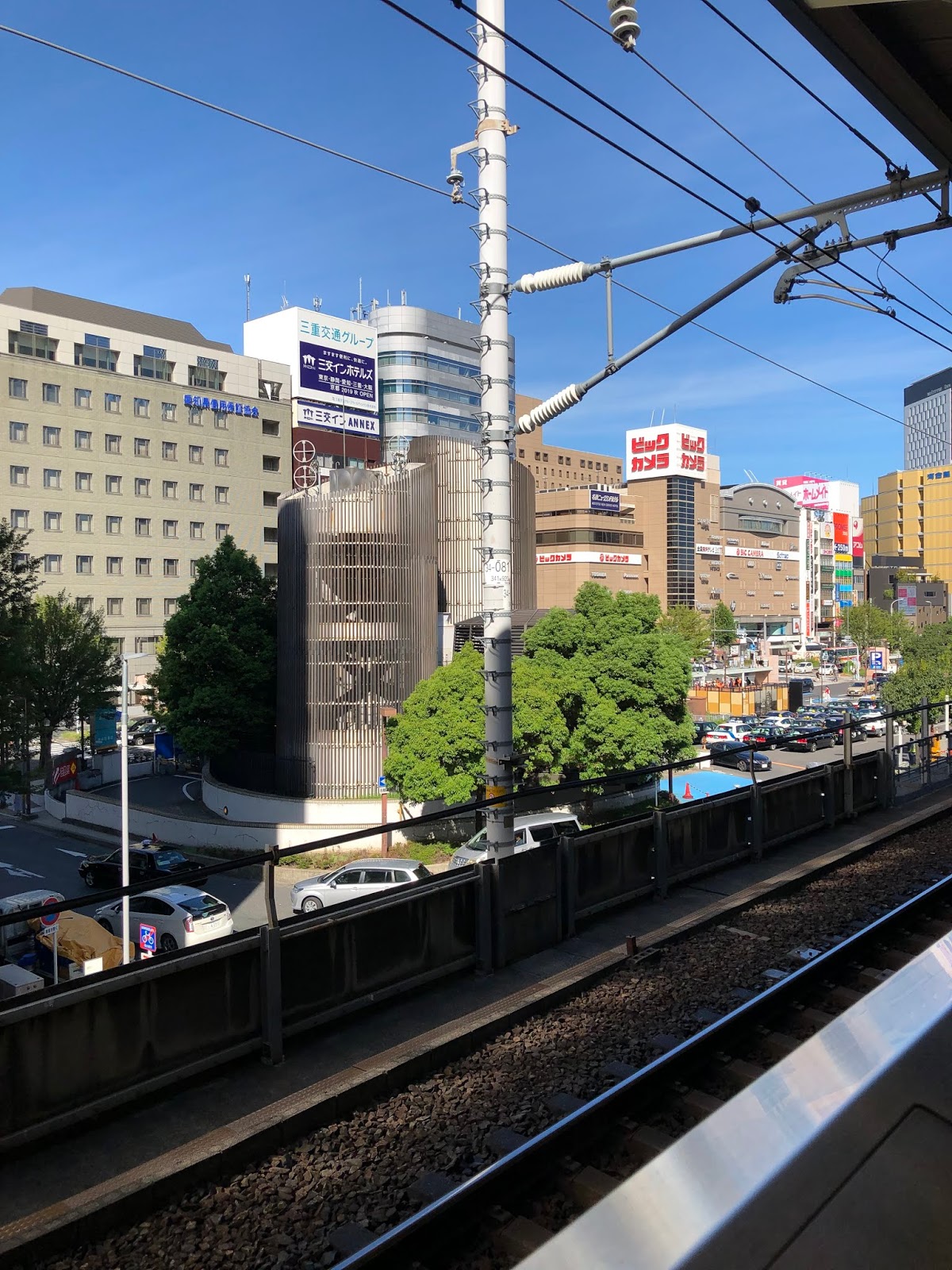
Above, Nagoya from the train platform and to the left part of the daily walk to the subway station pictured at the beginning of this post.

Friday, September 20, 2019

Two Special Shrines


I saw a castle, a palace and two gardens in Nagoya, a shrine and a garden and folk museum in Takayama, Temples and a shrine in Koyasan, a garden and art museum in Hiroshima, a shrine in Miyajima, one of the top gardens in Japan in Okayama, a botanic garden, two palaces and gardens, two shrines, and another palace in Kyoto, two shrines and the Imperial Palace garden and two art museums in Tokyo and I've likely forgotten one or two.  Most of the buildings are reconstructions as the originals were bombed in World War II.

Pictured above is Kinkakuji, the Golden Pavilion in Kyoto. This Zen temple's top two floors are covered in gold leaf. The original was the home of a famous shogun in the 1400s. It burned down several times in history, most recently in 1950 when it was set on fire by a fanatic monk. It was rebuilt in 1955. Gold leaf is continually made to keep up the two upper stories. There were lots of people here but it wasn't so crowded that I couldn't get a good spot to take pictures of the Golden Pavilion. You cannot go inside so this beauty is admired from a trail that goes around three sides and into the temple gardens that have retained their character from the 1400s.


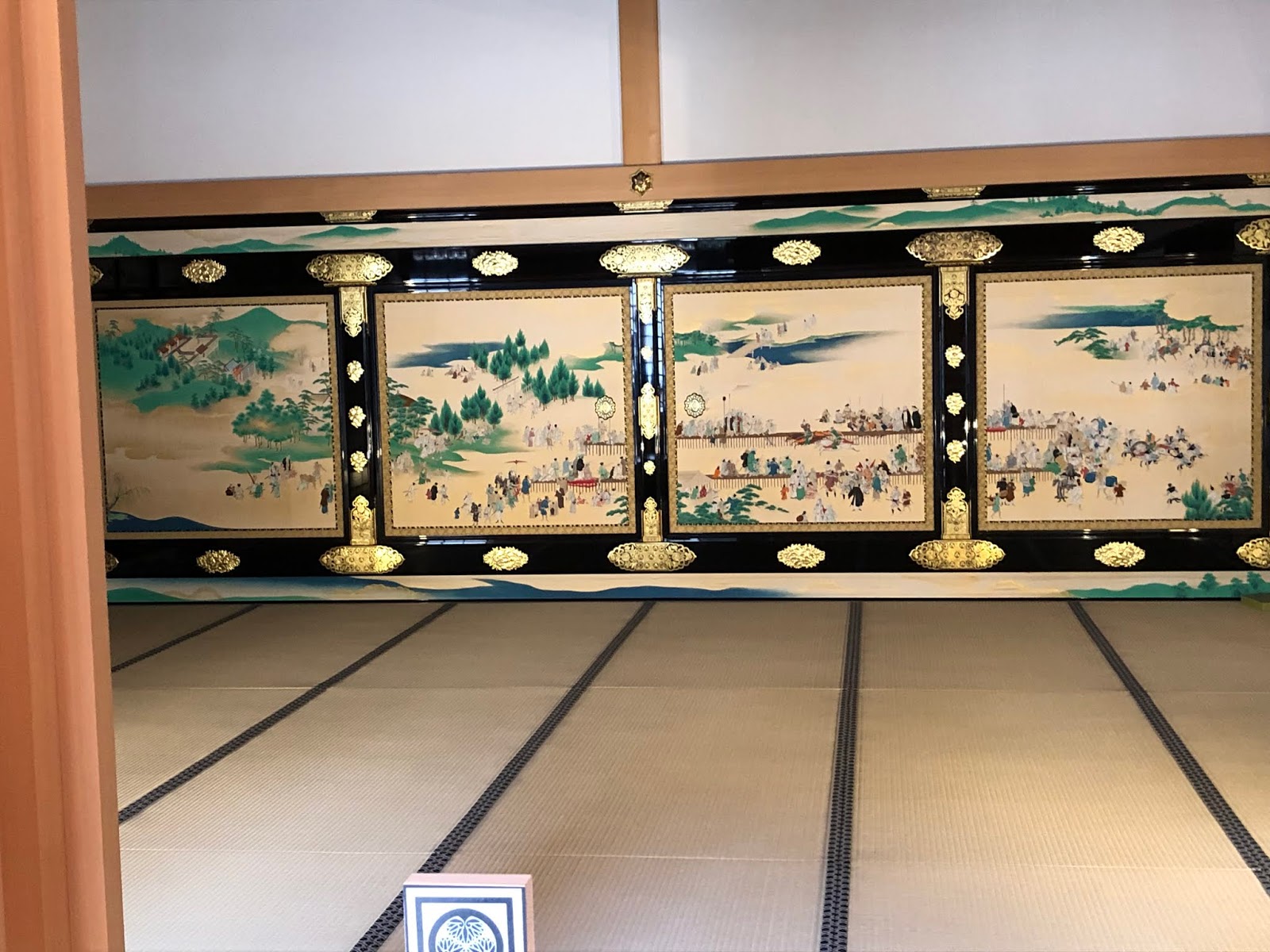
The art in the palaces is similar but I have the best shots from the palace in Nagoya because access was best. It's called the Hommaru Palace and like others was destroyed the war time air raids in 1945. It's restoration is recent which makes a difference in the vibrance of the screens. We're told that a wealth of historical records and over 700 photographs allowed for accurate rebuilding and restoration of this palace to its grandeur from 1615 which the original was completed. It was originally the residence of the first feudal lord of Owari.


 Nagoya Castle was the most stunning from the outside of any I saw. We weren't able to go inside because of restoration work. The website says it is being restored to its original condition. It was badly damaged but not destroyed in 1945.
It was originally completed in 1615. This photo doesn't show the votive tiger fish that tops the castle but it is there. I was able to enjoy these treasurers with my friend Jenni who with her husband and daughter recently moved there and Arlene who with me took Jenni her dogs.

For anyone who reads this and doesn't know, the two dogs weren't allowed to go with Jenni needed to leave to get her daughter in school. She paid our way to bring her the two adorable 15-lb. doggies that shared our foot room on the plane. That was the only reason I would have gone during this extremely hot time of year--temperatures in the high 90s with 60-70-80% humidity. My hair looked as if I were at the beach the entire time!
I'm going to make this blog post shorter both for you the reader and for me. That means I'll do more but makes the effort easier.

Thursday, September 19, 2019

Hiroshima and the island beyond -- Miyajima


Yes, for those of you who saw my Facebook post on Hiroshima, this is the same building--called the Atomic Dome, one of the few buildings to "survive" the atomic blast. The bomb detonated 160 meters southwest of what was then the Hiroshima Prefectural Commercial Products Exhibition Hall. The interior was gutted and all there died instantly but this exterior survived. It is a chilling reminder.

I hired a free guide for this excursion. That meant that i paid any bus, train or entrance fees for both of us and bought her lunch. My guide was 68-year-old Emiko, a Hiroshima native who had been guiding visitors for ten years. Here she is. While you may not be able to tell in this photo, she came about to my shoulder. She walked quickly but with an almost shuffle on her toes.

We agreed to meet at the exit of the JR train at the station. From there we were going to my hostel to leave my backpack. I suspect, though Emiko was too polite to say so, that I was her first client to stay in a place like my guesthouse, Mange Tak. She had no idea how to get there and wasn't at all familiar with that area. I would have had better options with my rail pass, but buying her a ticket would have cost more. The Hiroshima Information Desk person quickly made sense of her directions to me but Emiko had to understand in different detail. She was the leader after all. I understood where the guesthouse was when we got off the bus but again she needed to lead--and it was just around a block out of our way. The Mange Tak staff person was very clear about how we could walk to cross the bridge into Peace Park. Emiko used her sweat cloth (a necessary item) to wipe her forehead several times as we walked along the street. Even though the intersections were a bit confusing, she was visibly relieved when we reached the bridge. Soon she could do her job. NOTE: Japanese do not walk against the lights! Never--well almost never. I saw one man walk after the light turned green on a side street in Tokyo.

Once at Peace Park our first stop was the Peace Memorial Museum. The exhibits that showed what happened with old pictures, archived films and models are truly horrific! It is not for the faint of heart. All the exhibit explanations are in clear English as well as Japanese and I didn't need Emiko there. What she provided was the impetus to keep on going through the exhibits no matter my urge to bolt and say that was enough. I eventually did, but only after viewing several family stories of the effects of the bomb over time on their health and financial situations. I didn't spend much time with the development of the bomb--I live in Tennessee and have been to Oak Ridge and heard the bomb development story more than once. I skimmed the pleas for peace too as that's in my DNA, but those exhibits are clear and hopeful. The flame that burns in a memorial in the park will not be quenched until all nuclear weapons are destroyed.

I was, as many are, most touched by the story of the 10-year-old girl, Sadako, who got leukemia as a result of exposure to the lingering radiation. She believed that if she could fold 1,000 paper cranes--a Japanese symbol of good fortune and longevity, she would be cured. She died before finishing the 1,000 and her classmates finished them for her. There are class cases full of brightly colored paper cranes near the memorial above.

Since Emiko was a Hiroshima native as were her parents, I asked about her family's situation during and after the bombing. Her Mother, living in a suburb with a baby boy, was a nurse called into action to help the survivors. She answered the call with two others from her area but found that there was little she could do. She didn't talk about it very much until near the end of her life. She died of cancer but was in her early nineties. Emiko was born after that with no ill effects but blamed the radiation on the fact that her younger brother had six fingers and had a child who had six fingers. I asked why her Mother stayed in the area. Her father was a soldier stationed in New Guinea so her Mother was alone with a young child and from her point of view, couldn't leave. 

There was more, more exhibits, more memorials and as always beautiful trees. I did ring the peace bell, a wonderful resonate sound. After we toured the memorials and were both dripping from the heat, Emiko guided us to her favorite restaurant for lunch. I wasn't willing to chance a nicer lunch and encourage her to do the same for my budget didn't need straining. She was welcomed by name so it was obviously her regular lunch spot. She had a plate of noodles, cabbage and other items I couldn't name. I was very boring and had thin-sliced lamb in a slightly curried sauce with, of course, rice--and three glasses of water. I'd finished my thermos long before lunch. 

During lunch I learned that Emiko, who spoke and wrote English such as "we go to gardens now. We meet at train station" had been an English teacher. She laughed and said broken English speaker was English teacher. It wasn't so difficult to understand why most Japanese speak no English! (I also was told that many Japanese children aren't interested in learning English though it's part of the curriculum.) All but one of the more fluent English speakers I met had lived in the States for a year or more. 

Her plan had been to take me to the Hiroshima castle but when she realized I'd seen the castle in Nagoya even though we couldn't go in, she asked if I would rather go to the gardens. She didn't think we had time for both. I voted for the gardens but with another place in mind. After a couple of buses which she understood Emiko and I were quickly walking down the sidewalk when I saw it. "There's the art museum," I exclaimed. "Have you been there? There's an especially large Dali on exhibit there," I said. "You want to go?" she asked as I walked toward the entrance. She thought it might be closed since there was no line or people going in or out but it was open. Emiko had some sort of pass that allowed both of us, once I showed my passport, to go in free. The Hiroshima Prefectural Art Museum was mentioned in my Frommers book. The Dream of Venus was the large Dali on exhibit. It was the first piece was saw as we went into the exhibit hall. The other important piece noted in my guide gook was one called the Holocaust at Hiroshima by Ikuo Hirayama, an acclaimed Japanese artist who was in junior high when the bomb was dropped. It too was in the surrealistic style. There might have been a dozen people total in the entire museum and the paintings by newer young Japanese artists were wonderful. They were hung thematically where possible--darkness and those included a wonderful moonlit landscape and shadows in a garden and another of dancers and partiers. I wanted postcards of some of those paintings but alas only "masters" were in the gift shops collections. 

I lingered too long I'm certain in that wonderful museum for when we went to the gardens next door Emiko said we only had time to walk through half of the garden. That half was wonderful and I insisted on slowing down--she asked what was wrong--to take it in. 

Near the end of the gardens Emiko wanted to buy me a tea from the drink machine and we sat and watched the koi swim nearby. Afterward I insisted that she go with me to a bus stop I would understand so I could get back to the Guesthouse without getting lost.
I need to move through more quickly but must say a bit about Guesthouse Mange Tek where I stayed in a reasonably comfortable curtained lower bunk with four young women three of whom were American and amazingly considerate and quiet for $25. The young staff members were absolutely wonderful! The bar tender was Canadian and it was relaxing to have a beer and visit with him. The young woman who greeted me for the evening was clear with what she said but had a limited vocabulary. She recommended that I talk to the woman who came in for the morning shift. She had perfect English and was able to save me enormous time with her directions to the ferry I needed to catch to go to Miyajima Island. I had a route mapped out but could tell that getting back that afternoon to catch the train toward Nagoya and making the Japanese garden stop I planned wouldn't work easily with my plan. Everything at Mange Tek was perfectly clean. Our floor was female only with a code for the door but the men from the floor above used the showers and toilets outside our room. I didn't see or hear a man until I was leaving and a man came in his Japanese robe for a shower and shave.   

Miyajima Island is a UNESCO site, but the memorial that makes it famous is wrapped for restoration at this time. I knew that but decided to take the ferry over anyway. It was billed as a charming island. I am jaded I know but the area around the waterfront reminded me of Gatlinburg--nicer than Estes Park perhaps but similar too. I did pay to go into the shrine related to the gates that stand, when the tide is in, in the water, and took photos of the wrapped shrine. My favorite part of that island, and I didn't have enough time to hike all the way up--and perhaps wouldn't have anyway as I stopped when the trail began to get very steep and rocky was the trail that goes to the highest point on the island. My red sandals are good to a point! The young bartender had recommended it and told me where to access it after learning that I love to hike. Once again I was almost alone. Some came to the chair lift but most of them came another route and I saw only two young people after I hiked beyond the chair lift entrance.
     
          On the ferry going toward the island                                   A respite on the trail
 The Miyajima Shrine for Hiroshima and above the gates covered for restorative work. Look carefully and you can see the gates.


Wednesday, September 18, 2019

A Long Journey to Ekoin Temple Koyasan


There is so much about which I could write. I will write about the culture and those experiences, but first I want to process and write about some favorite places and experiences. This post focuses on my trip to the Ekoin Buddhist Temple on the mountain called Koyasan. The photos are of my room and the gate to Ekoin.

While I read about Koyasan in my Super Cheap Japan book, I did not see an easy way to make a reservation and the writer made it clear that this was not a budget stay. He recommended a capsule hostel instead. However, my Frommer's travel guide had the name of one, Ekoin, with an English website for reservations. My guess after being there is that many others have the same but that was the one I knew about. I had a plan, but changed it when I realized my traveling companion who sometimes attends a Buddhist group might want to go with me. With some difficulty, we made the reservations for September 1st. She changed her departure date to stay over for this trip and i changed my plans to go from the Temple to Hiroshima. 

Once in Nagoya with our friends, my traveling companion overdid and became exhausted with a painful foot. She began to talk about canceling her part of our reservation in Koyasan. Before we left for our mountain stay, she made the decision and let Ekoin know that she would not be coming. That meant that my first foray into more complicated train travel would be alone. Our host looked up possible ways to get there and made copies of three ways to go. I took two with me and early on Sunday morning a week and a day after our arrival, I started on my adventure. There were four changes after I left Nagoya station and I would likely miss one of them the first time but would find my way by close to the two pm check in time.


Two subways to Nagoya station above--we'd done that when we went to Takayama and to get my rail pass validated. I had that one down. Reserve a seat on the Hikari JR to Shin-Osaka. I knew where to do that too. After that it was new territory. I opted for changing to a JR local and asked the man who checked me out which track I needed. Note: With a rail pass I couldn't go through the usual machine entrances and exits but needed to go through the staffed gate. You might think those persons could always speak some English. That wasn't true, but the man in Shin-Osaka could read my schedule that said "Local train to Osaka." It was on Gate 2. I rushed down the escalator and stood in line. Nothing on the sign clarified which of the trains coming to that gate, I needed. I must have looked askance because when I looked down two Japanese women were looking at me with concern. I asked if the train pulling up went to the Osaka station. Looking at each other, they decided not, but changed their minds at the last minute as the three of us looked more closely at the train's scheduled stops. From that train, it was easy to find the next one. It would take me to the station where I needed to buy a ticket for the privately owned train to Koyasan. 

Okay. It was thirteen stops on that train to my stop. This announcer's English pronunciation of the Japanese names wasn't at all clear but I counted the stops and watched for the spelling--once in English on the signs at the stations--Shin-Imaniya. There I left the JR station and walked to the Nankai-Koya Line where the agent said as I walked through, Koyasan? I nodded. He pointed to the ticket window. The agent was able to make me understand that I was buying a round-trip ticket from there to Koyasan. Up on the platform where there was a sign to Koyasan, I was supposed to take the Express but I wasn't clear about the train that pulled up and got on anyway. I didn't want to wait. 

As I looked at and heard the destination of this train, and as we stopped at every crossroads, I began to wonder if I'd made a mistake. In that little station could there be a train that didn't to to Hashimoto Station, my next stop? I was sitting next to a young Japanese man who'd smiled and said Hello. He might speak English I thought. I turned and asked if he knew if that train went to Hashimoto where I could catch the train to Koyasan. He didn't. He wasn't from that area and didn't know much about those trains. Between us we decided it was safer to get off that train at the next stop where we saw Koyasan on the station destinations (I'd already noticed two) and I'd catch the Express that said Koyasan. He'd get off with me. He didn't have a time schedule and was just going to spend time with friends. We found the track for the next Express easily and I told him he could go on. I was fine. No, he said. He would stay until I caught the train. Then he would take the train back to his stop. He wasn't in a hurry.

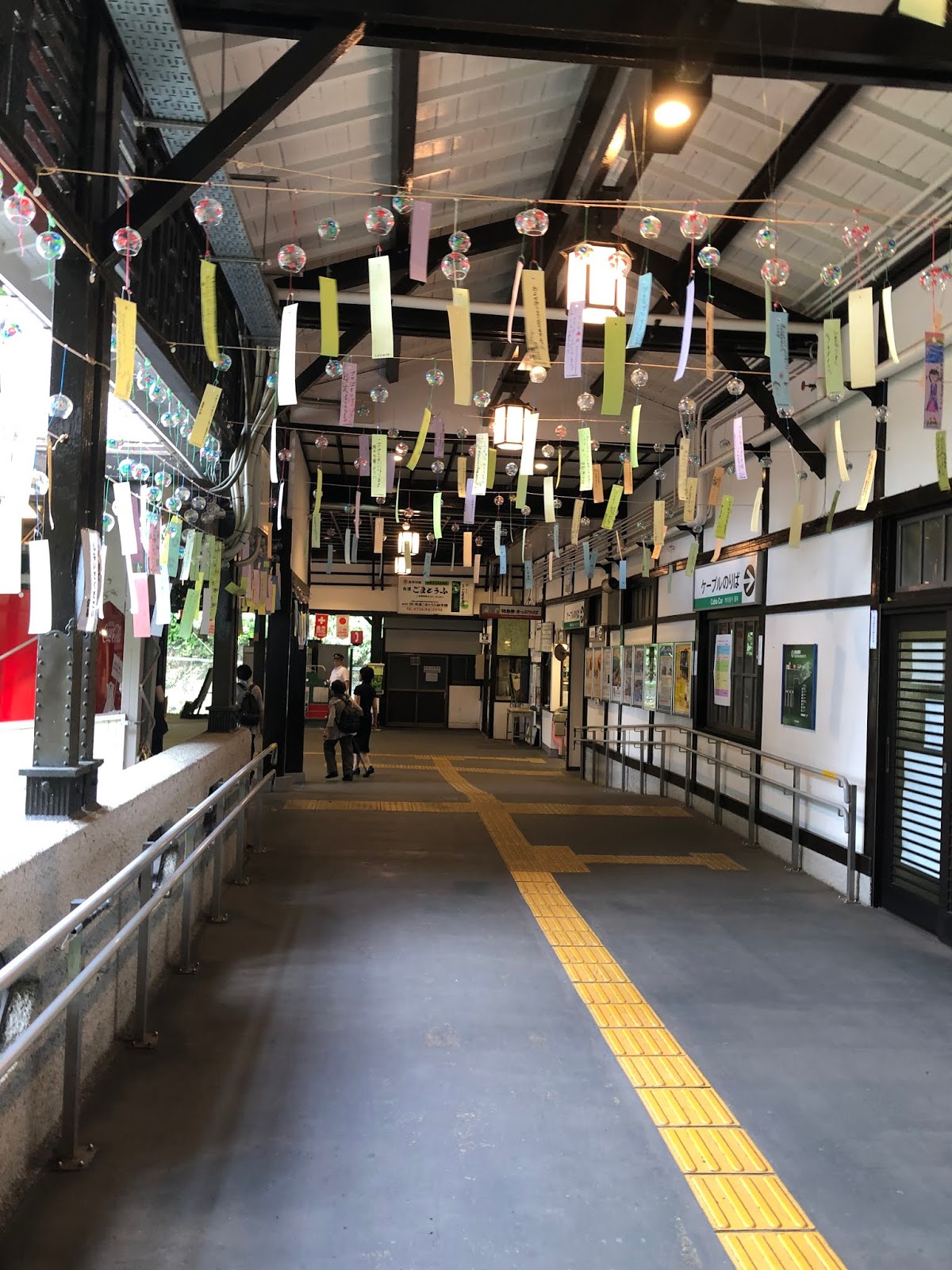
That Express still stopped at several towns but when we reached Hashimoto Station the train up the mountain was waiting. A young couple sitting near me was going to Koyasan too. We boarded an almost full short train that squealed and screeched as it took the curves and climbed the mountain. We pulled off for the downward bound train to pass. This old train reminded me of the one I took from Ashton Idaho to West Yellowstone Montana when I worked in Yellowstone summers in college. These photos are of that winding train ride and a lone man at a station stop on the way up.


Our next stop was to board the cable car to the top of the mountain. It was much bigger than I expected. This was when I began to realize that Koyasan was indeed a tourist destination. 


After a short bus ride I followed others to Ekoin, was met by a monk, ushered into a room where two couples were waiting. We were joined by more couples. Then the monk gave us guidelines, we completed information cards and paid. At that point I was the first to be led to my room. It was at the farthest corner spot just before the stairs that led to the meditation rooms and the Temple. Since those stairs were only used when we were to be in those rooms, it was a quiet spot. The room was as pictured above when I arrived. To the right of the fan, you can barely see what's a sliding door to an outside porch where a table with two chairs sat. The lush greenery outside made that a welcome spot for reflection and to read the story of Ekoin and other suggestions in the book you see on the table. 

Meditation was similar to other Buddhist practices I'd experienced--sitting crosslegged or with our legs under us with eyes downcast but not closed and to focus on our breathing. The explanation of their Esoteric Buddhism was appealing. Their aim is to be one with everything in the Universe. It's not about perfection but about oneness. After meditation, which was to clear our minds, we were ready to return to our rooms for our evening meal served there.

The trays of food were beautiful and nicely placed on very short legs on my floor with the table moved to the side. I can't tell you what I ate other than rice, soup, a small dish of raw veggies and an orange. Gelatin is used in various ways and after asking more than once, my friend's new Japanese friend said the large bowl in the center is likely vegetable broth in gelatin. The monks are vegetarians so I knew that before hand. I had the choice of two or three trays and chose two. Whatever I ate that was unfamiliar was tasteless but I felt as if I'd had a full meal without eating all of the rice. (I'm not eating rice for a few weeks.)

I'd signed up for the cemetery tour prior to arrival. Our Temple was the meeting spot as our monks were leading the groups--Japanese and English speaking. While the group was gathering, I met the only American couple I would meet on the trip. They were from Florida and weren't particularly taken with the monastery where they were staying (not ours). They were going on to Hiroshima from Osaka as I had intended. 

The monk who led our cemetery tour was a talented group leader with strong English skills. He told us that anyone of any country or any faith could be buried in that cemetery but would have to arrange to get their remain to the cemetery themselves. We walked through a candle-lite area and stopped in front of the Mr. Nissan (of the automobile) section ready for him when he dies. He said that the Shintos were best for celebratory rituals, the Buddhists for rituals and prayers for the dead and that all women wanted to be Christian, wear a white wedding gown and be married in a church. His Mother was Shinto and Buddhist and was married in a Christian church in a white gown. We walked to the most holy burial place where he asked that we were quiet. He sang the song for the dead beatifically. It way moving.

On the way back I walked with a couple of French women and the guide and he shared about his background. Many of the monks are sons of monks but he was not. He made his own decision to become a monk. They can marry and he had a wife and a son. He lived in a house away from the Temple grounds with his family and drove in every day.  He was not going to require his son to become a monk he said. They could drink sake or other alcoholic drinks though he did only on special occasions. He had been there one year and would stay as many as five-ten. Then he would go back to his home Temple. 

For the early morning, we were invited to the Temple for the 6:30 prayers for the dead followed by the fire ceremony in another building. The onsen for bathing opened at six and I was there. Shared toilets were on every wing of each floor but the onsen was the only place for a shower. The onsen was 
a place for soaking and I didn't have a lot of time but I showered and washed quickly and got into the onsen for about five minutes. The water was extremely hot so I got in slowly. It was a square pool of still water about twice the size of two large bathtubs. Traditionally an onsen had natural spring water but it had become an important facility in many places to spend the night. Any woman could have joined me but only a Japanese woman putting on her makeup in the large powder room was in sight.

                                              From the deck around the Temple
I hurried to get to the ceremony of prayers for the dead. We were asked not to photograph there and while I saw others slip out their phones, I did not. At the end the monk who communicated with those of us who spoke English (the others were mostly Europeans) came out of told the first couple on the other side of the front row to go to the small altar in front and honor the Buddha. They had no idea what to do but knelt and bowed and went on. As the group moved through one at a time, it was easy to see which were either Buddhists or who had experience with the ceremony. A few had coins to toss as we were supposed to be praying for our ancestors. As the last of us circled through we were asked to hurry and get to the fire ceremony. 


I had to make a stop and was one of the last to enter the building where our monk was chanting and building up the fire by tossing in the prayer sticks which we'd paid $3 for and on which we'd written a name and prayer request. His voice rang out, the drums beat and the fire leapt and danced. The ceremony continued until all the boards burned and the fire dimmed. Then the monk suggested that the fire was healing and we might want to come down and wave a hand into the smoke and bring it to a body part or our heart, whoever we needed to heal. After that we headed back to our rooms for breakfast. While I was away, my futon was taken away and my breakfast left by one of the monks. 

Many packed to leave but during the night's cemetery walk I'd noticed the tall trees and took the monk's suggestion to see it in daylight.

I packed before I left and as I took my backpack down to the storage area I noticed that the shoe bins were emptying. I officially checked out but left my backpack and the blue bag I carried and headed toward the cemetery. Before I reached the cemetery gate I passed a small gold Temple that beckoned me in. As I stood in the doorway, a woman came over and motioned me to take off my shoes and come in. It was lovely with architectural details so very fine.


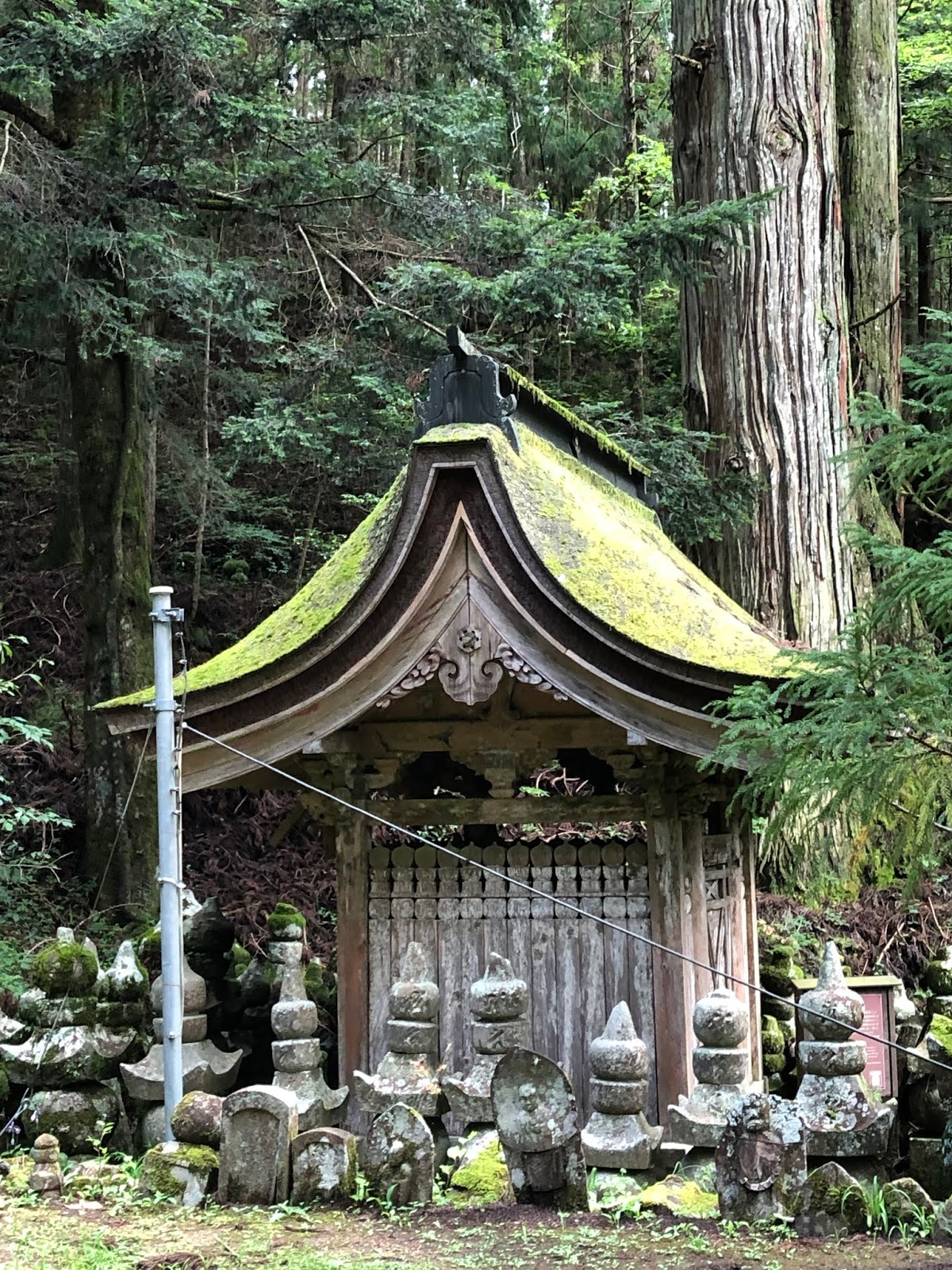
From there it was the cemetery that called. I have so many photographs of the tall wonderful trees--300 - 600 years old our monk said and each numbered and protected by the Japanese government. This entire mountain is a UNESCO World Heritage Site but I thought the cemetery should have its own designation. Here are a few of my favorite photos.                                                                                         


As I look at these photographs there is no way they convey the majesty of these camphor trees. I luxuriated in this forrest filled with old stones and monuments. When I went back to town I did shop a bit but bought only woven book marks. I also walked a mile or so to the grounds of the temple that houses the leadership of this Buddhist group. I intended to close with a photo of the gates of that Kongobu-ji Temple but my photo tab has stopped for the night. Perhaps I can add it tomorrow. If not, know that even with its commercialization, Koyasan is a very special place. It's worth the effort to get there and dealing with the accident that halted my train back to Osaka allowing for a conversation with the only Japanese person I met who had heard of Tennessee. Not only had he heard of Tennessee, but he wants to visit the Great Smoky Mountain National Park!


Sunday, September 15, 2019

On the Way Home—Memories of Japan

I saw many gardens. In the heat of not-yet-fall I had to watch for blossoming vines. The one above was in the Imperial Palace Gardens East. I found a couple of others there too on the edges of the tall trees and carefully cut shrubs. It was so hot the day I visited that signs were out warning of heat stroke. The young Australian man—grandson type—who walked with me from the train station and I took advantage of the “cool house”where visitors were encouraged to cool off in air conditioning and enjoy a cold drink. Drink vending machines are everywhere and drinking fountains reside near bathrooms in museums. Most places the best bet for water if your bottle is empty is a vending machine for 120 or 130 yen. That roughly translates to $1.20 or 1.30. Keeping a supply of coins is important. I have a picture of the vending machines but it’s on the camera so not yet available.

I’m writing from a loud coffee/Internet cafe and bar in the Detroit airport. Jenni apparently thought customs would take a long time so I got in from Nagoya about 3:45 and have a 10:36 EDT to Nashville. Once settled in Japan, I could only access this website in Japanese!

I walked not so gracefully around this park enjoying watching people gathering to visit or sauntering through the streets getting tired before coming upon the Tokyo Metropolitan Art Museum. The building is low to the ground and many of the viewing galleries are underground. The information said that it was built so it wouldn’t take away from the views of the trees and shrubs in the park. I was delighted to find an impressionist and post-impressionist special exhibit from the  Courtauld Collection in London! It was beautifully hung with scenes from life in Paris or at the homes of the artists interspersed. The Cezanne painting of Mt. St. Victoire made me “homesick for Provence as driving north from the village where I lived this mountain pointed the way.

It’s hard to keep on WiFi here and frustrating so I’ll sign off for now.

Much of the time I toured around alone, looking for the train or subway and the exit from either that would turn me out near the shrine or museum I wanted to visit. That's why it took so long to find the art museum in Ueno Park.

I took this picture in Ueno Park because the locals were photographing it. This large tree was toppled by the Typhoon that drenched Tokyo on Sunday night and early Monday morning before I left for my Tokyo visit. It is so unusual for the winds to bring down such a large specimen that it gathered a crowd. My train was about an hour late and my plan for reaching the hotel I booked had to change because the local JR trains weren't yet cleared to run. A lovely young man, another grandson type, had free time because his girl friend's train wasn't running so she couldn't meet him in Tokyo. He and I found an alternate route to my hotel and he went along, carrying my backpack which held my big camera.

This is a very disjointed blog post which I'm completing after arriving home at midnight. I'm going to leave it at this and write more on a new post.


Tuesday, August 27, 2019

On the way—Nagoya Japan

We arrived Saturday at 4:30 with the two lovely dogs—Ippie and Chocolatine—belonging to my friends the Joys who moved here for his job and needed to come earlier than the dogs could come so that they could get furniture, move into their rental and get their 15-year-old daughter into school.

Immediately upon leaving the Delta desk a man with a chair came hurrying toward my friend. She got him to take her dog and then motioned for mine to be put onto the chair too. The man with her dog took her from the cart and carried her into the security area motioning another man to take mine. This kept happening. We got off the Flight in Detroit and my companion commandeered a young man with a chair waiting undoubtedly for another passenger. After he’d taken our dogs more than halfway from Gate 32 to Gate 54 where the doggie rest station was, he said we could take it ourselves. His boss couldn’t see him with a cart void of a person. We took charge of the cart!

Add caption


Upon arrival at the doggie rest station, Ippie jumped right out. Chocolatine moved to look out but sat in her carrier. Neither dog was interested in peeing or standing near the Green fake grass area you see behind me. Chico finally got out and both ran around. 


We lured them back into the carriers with their favorite Trader Joe’s roasted cashews. Back in their carriers and our cart, they sat facing each other while we ate sushi.

You can tell from the size of the carriers that they didn’t fit under the seats in font of us. We pushed and shoved and got the metal bar to bend enough to get them part-way in—father on the short hop to Detroit. On the long leg, I eventually moved across the aisle with the two little girls who’d extended their reign so my doggie could have her carriage out enough to have the extension open.Then they seemed happy to sleep to Nagoya!

Since arriving we’ve shopped more than I had in the last years. My companion is an artist who wanted fabric scraps and used kimonos.Yesterday we found both in old town area of little shops where we spent more hours—-.

This is the covered-shop area where we spent hours yesterday.We did find a good sushi lunch, went on another long train ride to get my rail pass validated and to a store for items our hostess’ daughter needed for her school retreat.

Today we toured the Nagoya castle and palace. The castle is closed for renovations but the palace was lovely. Much of it was destroyed by bombing in 1945 but has been faithfully restored.


The Nagoya castle and a room from the palace.